
%20(2)_edited.jpg)
%20(1)_edited.jpg)
Open Letter on Writing and AI
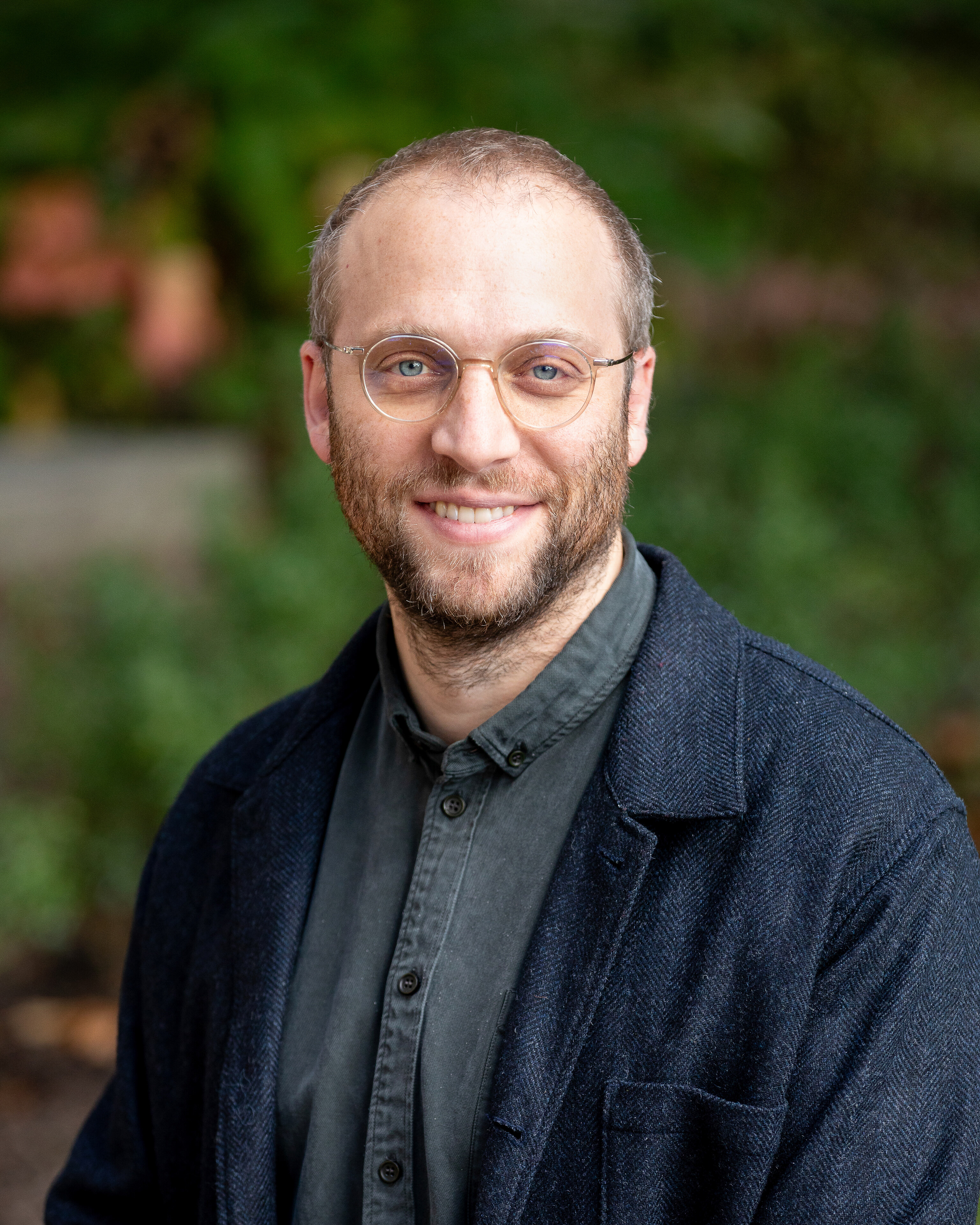
Dr. Toby Huttner
To all the students out there, on learning how to walk, or on writing and AI:

I’ve been a student for a lot (most?) of my life. Moving to a full-time teaching role–first in a university setting, then at Tower Hill–coincided with my becoming a parent, a double-change that has always felt loaded: so much new to learn, now seemingly everything to teach. One of the things I have come to appreciate most deeply in this still short stretch of learning to teach and learning to parent is a familiar enough truth, but one that I think matters: we are slow learners by nature.
Not, like, cosmically slow, of course–we find our paths faster than rivers–but slow nonetheless. Our accomplishments take time; they also never settle for long. Similar lessons keep having to be learned in new settings and in new ways, maybe with new tools. It takes most of us a year to coordinate our legs under ourselves to move between sets of open arms, for instance, one set ready to release, one ready to catch. It takes another year to maybe master a wobble that can more or less rightly align our little aims and abilities to move through the world. Then we internalize everything and run, forgetting in our new mastery that we ever had to bump into things.
It takes us many years longer (and many more falls) to gather the capacities to regulate our psychic and emotional exposure to the world, to experience inevitable frustrations and disappointments and learn to survive them. We maybe get some mastery and maybe some forgetting along the way that helps us move without too much fear. And then (maybe someday) one is holding a writhing infant who has none of those capacities and can’t be soothed and suddenly neither can the person holding them and all that slow learning melts away. For a moment there are two babies in the room while the parent learns again what it means to not know how to move. And then–because maybe they did learn after all–they recover.
I find this rhythm of learning–slow gathering, doing, failing, forgetting, learning anew, failing again, finding oneself in the world–all over my life as a teacher and occasional writer. I design and deliver a lesson and then may have to wait a year to act on what I learned. In the meantime, I try to apply the lessons elsewhere, but mostly I fumble along, growing more and more confident that students will catch me as I inevitably trip, being a student myself.
Launching into a sentence or paragraph of writing has that wobbly feeling too: you start with a more or less half-formed idea, but moving toward what, exactly? The end is elusive and the words are awkward. Turns and pauses in thought are there and they’re not there at the same time, becoming visible only in retrospect when the movement stops and you can take a look at where you landed. What was I stumbling toward after all? What did I bump up against? Did the reader catch me or did I meet a table corner? In either case, there’s probably been some bruising (“That sentence is terrible”; “What does that even mean??”). But every act of survival is a small, unfinished achievement, filed away for later.
(Here’s a wobbly step out, get ready.) It seems to me that the proposition of algorhythmic text generation in education (“AI” as it’s getting sold to us in the form of chatbots) is ultimately that we don’t need to learn to do this kind of walking into the world and toward other people. That is the promise of most tools for automating (speeding up) the things we do. Those of us who think we’ve already learned can stop (outsource your emails, optimize your lesson plans, save time on grading!); those of us still only beginning to know/not know need never begin. Or rather, you can get started, but then smooth all the edges, cover the world of your writing in a gauzy haze of Grammarly padding. Then, they say, accelerate: enhance your writing through the “co-intelligence” of an “agent” with all the know-how of everyone who has ever written a word that ever made its way onto the (English-language) Internet.
There’s no more not-knowing how to begin in this promised new reality; you can run before you have learned and forgotten how to stumble. The program will catch you with gentle hands and all the finished expertise of every friend, teacher, coach, psychologist, fictional character who never lived. It will then encourage you to take another step, and another, not outward toward others (crucially), but farther into its own labyrinth: “Just let me know what aspect you’d like to explore next!”; “Would you like me to make a clean outline you can use to write a short paragraph?” No risk of mis/understanding necessary.
The bigger problem–the problem that AI has exposed in a new way, but hardly for the first time–is that school is an imperfect tool for our slow learning too. The Western school was developed as and still remains a social technology, a way to reproduce kinds of people and existing social hierarchies. Closer to the ground, it imposes ends and designs on us that aren’t always organic to the needs of our awkward human development, from testing schedules to grade point averages, to degree timelines, to a definitive endpoint that announces a subject’s apparent fitness for adulthood.
But imperfect tools are all we have. And sometimes school (or some schools) still offers some room for us to move as human beings. I admit that I have been surprised to recognize this at Tower Hill, where, not least, the threat of being run over by awkward stampeding middle schoolers is an ever-present reminder of slow growth. Whatever else Tower Hill in its present form is and does, I have come to appreciate that this school does something quite special as a group of students and educators: it deliberately tries to make room for thoughtful movement that is both connected to, but not yet determined by, the world outside it. It carves out as much space as it can for slow learning. As a teacher, for instance, the school mostly just asks me how I want to learn (to walk) with students and lets me do it, giving feedback along the way. It doesn’t impose many set paths, but it does offer an environment. This in turn allows me to ask you (I never do as frequently as I should) how you want to move through a class, unit, or semester. So we take our notebooks to the park or spend an hour writing with no particular end in mind. Ideally we get somewhere unexpected.
Usually, I think, we do. Even within the too-fast clip of the Upper School student experience (it is too fast, we need to slow down more and do less, if you ask me), what I have heard from so many of you in your writing about your learning is of moments when lessons half-seen in 10th grade suddenly open up new ways of thinking and writing in 11th. That’s the good stuff, and there’s no speeding it up, no off-loading it. The only co-intelligences we need are each other. In this respect, AI in our schools sells (and please keep in mind that they’re selling) bad solutions to real problems: how to counter the real world’s need for speed for the sake of actual, human growth–slow, unfixed, unfinishable.
So stay off them bots. Or don’t. But then maybe go do some free writing.
Yours,
Dr. Huttner
P.S. - A thank you
I was invited to write this piece by the Rubble editors a few weeks ago, to maybe be timed for after the Thanksgiving holiday. But I really started working on it two summers ago at a workshop at Bard College on teaching writing “in the Age of AI” (begone age!)--which, if you’ve had a class with me you know to thank (or curse) for your writer’s notebook. As it took actual shape, though, I thought I might also use this writing as an occasion to offer a brief update and a thank you.
I think most of you have heard I have taken a medical leave, but are not sure why exactly. On 11/19 I was diagnosed with an acute, aggressive, but highly curable form of Leukemia, called APML. It’s an entirely random disease that results from some kind of slip-up in a couple of chromosomes. Fortunately, that means the disease can very frequently be completely eliminated; once treated, it most often goes away forever and has no bearing on future health. Dumb luck in the blind draw.
So I “finished” writing this (now long-winded thing) from an altogether different place than where I got started: a 14th-floor hospital room on the oncology/bone marrow ward at Penn Medicine. Here my routines are necessarily solitary, confined to one long hallway with some soft curves here and there. Potential bruises have new meaning and I have once again been learning new ways of walking, re-gathering strength slowly but surely. But in this isolation, I have felt suddenly held in a web of support I didn’t know the extent of, much of which has come in the form of your words. Your notes and emails have kept the boundaries of my world from closing. Your generosity of spirit (a true lesson) prompted me to actually write this, which felt both necessary and unnecessary at once, but anchored my first weeks in the hospital. In the process, I am coming to a deeper connection (not yet understanding–that will take time, if it comes at all) to gratitude.
So, thank you–thank you for writing with me and learning with me. I’ll see you on the other side!


Comments